10 Money-Saving Challenges to Try This Year
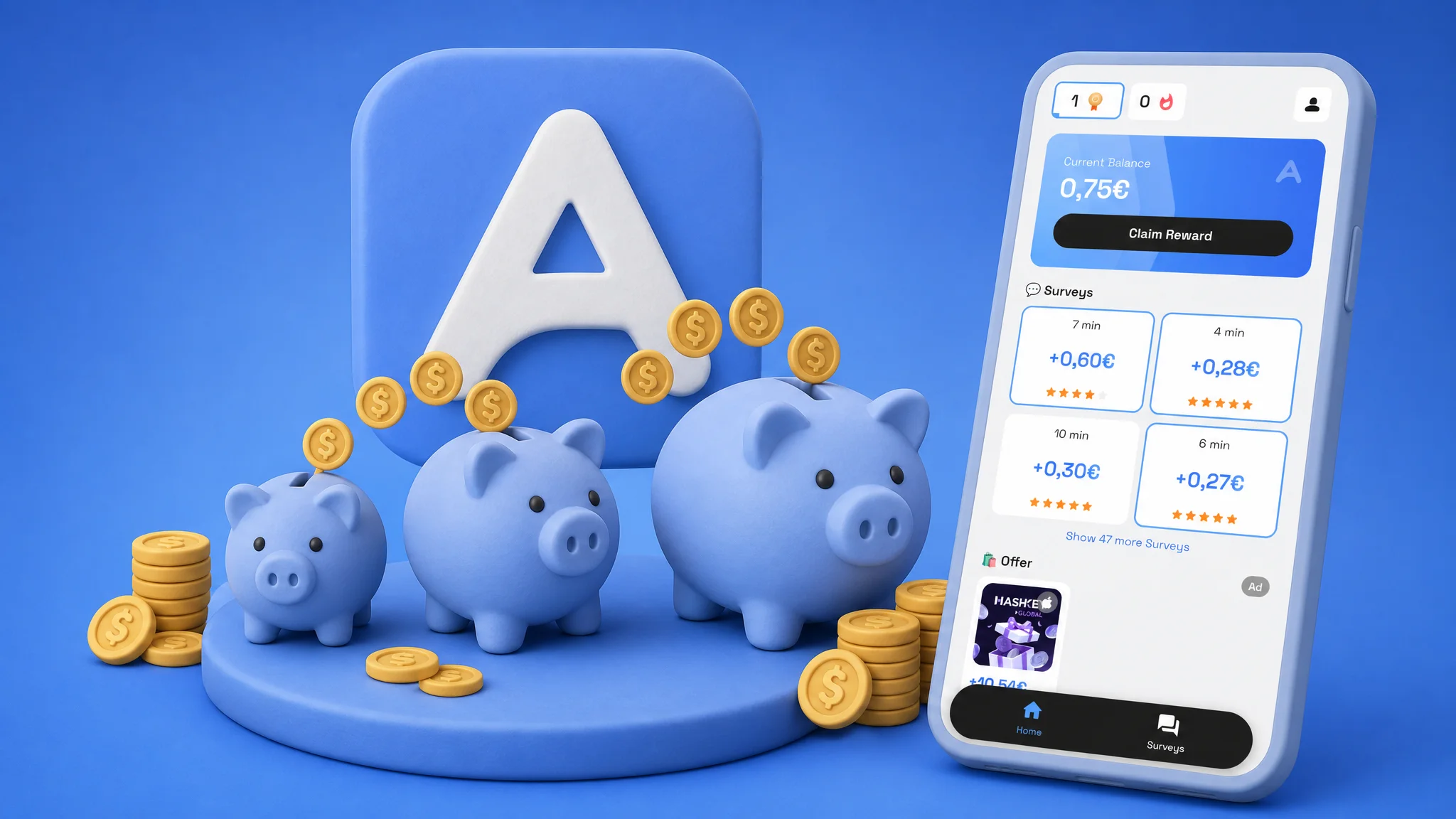
A money-saving challenge works for one reason: it makes saving feel like a game instead of a chore. The dollar amounts are small enough that you barely miss them, and the structure means you don't have to renegotiate the choice every week. Here are ten that have stood up over time, with the rules spelled out and an honest take on which ones actually fit a real life. Start in your browser at airperks.app, or download the app to fund any of them with a few dollars from short paid surveys.
The trick to a savings challenge is picking one you'll actually finish. Big numbers look great in a Pinterest screenshot; the version that gets you to the end of the year is the one that fits.
How to fund any savings challenge with AirPerks
Most challenges below need a small, regular trickle of money. AirPerks earnings are exactly that - a few dollars a week from short paid surveys, deposited into your in-app balance and cashed out to PayPal or bank transfer at the $5 minimum.
- Sign up. Open the AirPerks web app or install the mobile app - both work, no credit card required. The starter survey unlocks your first $0.50.
- Run paid surveys in spare time. Five-to-fifteen minutes per study, paid per completion. Run a couple per session. AirPerks layers Missions, Streaks, Bonus Day, Fragments, and Cashback on top.
- Cash out. Standard threshold is $5; once you hit Level 30, the threshold drops to $3. Pick PayPal or bank transfer - zero fees on both, you keep 100%.
- Move it straight to your savings account. Don't let it sit in checking. The whole point of these challenges is to make saving feel automatic.
How long it takes to make this work
The first $0.50 lands within minutes of signup, and the first $5 cashout is realistic in one focused session if surveys are landing for you. Some users have earned over $1,000 across the platform - real outcomes from people who built a habit, not a guarantee. Earnings vary based on your demographic profile, how often you log in, and which surveys are available in your region. For most savings challenges, even $5–$20 a week from spare-time earnings is enough to fund the whole thing.

The 10 challenges
1. The spare change challenge
Drop every coin you encounter into a jar (or use a bank's automatic round-up feature). The math is nothing dramatic - typically $50–$200 a year - but the friction is also nothing. Best fit if you actually use cash. Less useful in a fully cashless household, where the bank round-up version still works.
2. The $5 bill challenge
Every time a $5 bill lands in your wallet, set it aside. You can save several hundred dollars a year doing nothing else. Same problem as #1 if you don't use cash; same solution (use a debit card with a "save my fives" round-up rule, if your bank supports it).
3. The 52-week challenge
Save $1 in week 1, $2 in week 2, and so on. By week 52 you're saving $52, and the total at year's end is $1,378. Easier than it sounds at the start, harder at the end (the back half costs $1,000+). Smart variation: flip it. Save $52 in week 1 and $1 in week 52. The big weeks happen when you're motivated; the small ones happen during holiday-season-busy December.
4. The no-spend challenge
Pick a window - a week, a month - and don't buy anything except essentials (food, gas, bills). What you'd have spent on coffee, takeout, and impulse buys becomes savings. The point isn't asceticism; it's a one-time reset of habits. A month of no-spend usually shows you which of your "regular" purchases were actually deliberate.
5. The receipt-savings challenge
Every time you shop, look at the "you saved $X" line on the receipt and transfer that amount to savings. The math is non-trivial - coupons and store discounts can total to several hundred dollars a year. You're literally taking the savings the store advertised and making it real, instead of folding it back into spending.
6. The 100-envelope challenge
Number 100 envelopes 1 through 100. Once a day for 100 days, draw a random envelope and put that dollar amount inside. Sum: $5,050. Steep but finite. Variation: half-amounts (1 cent through $1, totaling $50.50). Smaller, friendlier, still a tangible pile by day 100.
7. The weather Wednesday challenge
Every Wednesday, put away an amount in dollars equal to the day's high temperature. Mild climates net you $50–$80/week in summer; cooler climates net less. Best fit if your weather is warm enough to be motivating but not so consistent that the challenge stops feeling like a game.
8. The habit challenge
Tax yourself for habits you want to break. Every cigarette, every soda, every doom-scroll session past a set time, drop $1 (or $5) into savings. The behavior modification is the goal; the savings are a side effect. Fun version: pay yourself for habits you want to keep - every workout, every cooked meal at home, drop a fixed amount in.
9. The side-hustle savings challenge
Take everything you earn from a side income - surveys, ridesharing, freelance gigs, whatever - and route it directly to savings, never to checking. AirPerks earnings cashed out via PayPal or bank straight to a savings account is the textbook version of this. The sideways benefit: the money never feels like spendable income because you never see it in checking.
10. The DIY savings challenge
Pick a goal ($500, $1,000, $5,000), pick a timeline (3 months, 6 months, a year), divide. The math gives you a target dollar amount per week or per month. The advantage of building your own challenge is the goal is yours - a vacation, a new laptop, an emergency fund - so the motivation is built in. The disadvantage is no external structure, so you have to be honest with yourself about whether you'll stick to it.
Which one should you pick?
Quick version:
- Most realistic for most people: the side-hustle savings challenge (#9). Spare income that wasn't going to be in your budget anyway is the easiest money to redirect.
- Most fun: the 100-envelope challenge or weather Wednesdays. Built-in randomness keeps it interesting.
- Best for resetting habits: the no-spend challenge or the habit challenge. The savings are secondary; the behavior change is the win.
- Best if you don't use cash: the receipt-savings challenge or the DIY one. Both work entirely on top of normal banking.
Frequently asked questions
What's the best place to keep the savings while a challenge is running? A savings account separate from your checking - high-yield if you can get one, but mostly the point is the friction of "I have to transfer this back to spend it". Keeping savings-challenge money in your checking account is the surest way to accidentally spend it.
Can I run more than one challenge at a time? Yes, but most people don't finish multiple challenges. Pick one. Finish it. Add another next year if you liked the rhythm.
What if I miss a week or break the rules? Don't restart from zero - that's the surest way to abandon the whole thing. Pick up wherever you are and continue. Perfect adherence isn't the goal; ending the year with more savings than you would have had otherwise is.
Will surveys actually generate enough to fund a challenge? For the small ones (spare change, the early weeks of 52-week, weather Wednesdays in mild climates), absolutely. For the big ones (the late weeks of 52-week, the full 100-envelope), surveys would be one funding source among several. Treat AirPerks as a real but small contributor and pair it with whatever else you do.
Does AirPerks itself charge any fees on cashing out to savings? No. PayPal and bank transfer payouts have zero fees on AirPerks. You keep 100% of what you earn.
Start funding your challenge
- In your browser: airperks.app →
- On your phone: download the AirPerks app →
A minute to sign up. The first $0.50 lands after the starter survey, and a few sessions a week is enough to feed most of the challenges above.
Earnings vary based on user activity, demographic profile, and survey availability in your region. Top user earnings of $1,000+ are real but not typical. This article is general information, not financial advice.